


Peasants Into Frenchmen - The Modernization Of Rural France 1870-1914
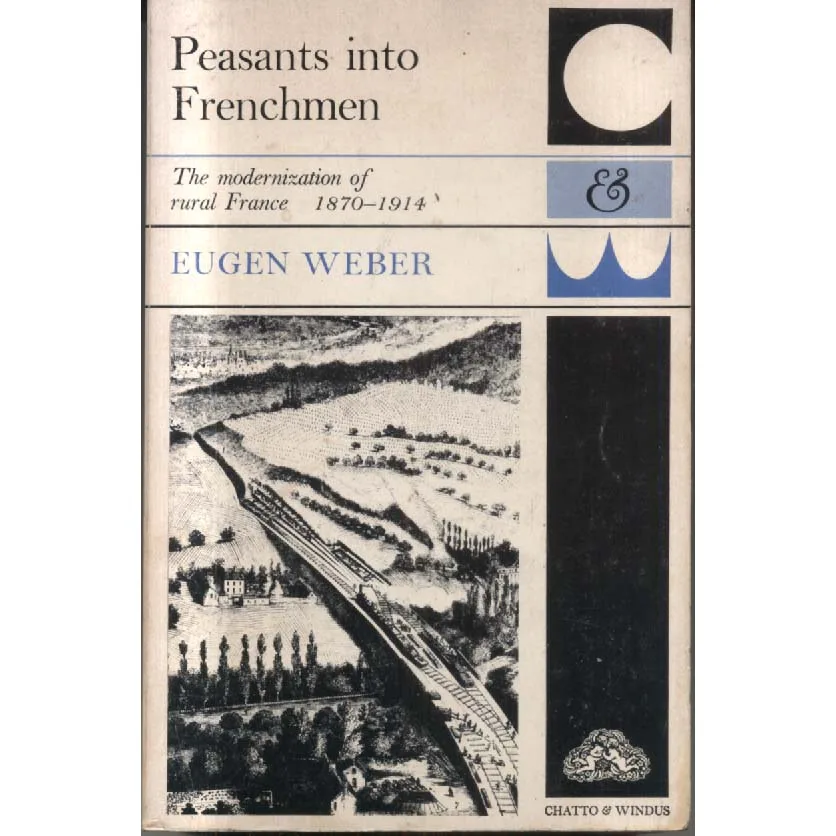
Publisher: Chatto and Windus
Format: Paperback
ISBN: 0701124393
Peasants into Frenchmen – The Modernization of Rural France 1870–1914 (1979) by Eugen Weber
Chatto and Windus
ISBN: 0701124393
Condition: Good
France may look wonderfully unified on a map, but Eugen Weber’s Peasants into Frenchmen sets out to explain just how much work was required to persuade the people living in all those villages that they were, in fact, part of the same country.
The title gives the game away rather neatly.
This is the story of how rural France was gradually drawn into the modern nation between 1870 and 1914, a period in which roads improved, railways spread, schools expanded, military service reached deeper into provincial life and the state developed an increasingly impressive enthusiasm for making distant communities conform to a common idea of Frenchness.
Before this transformation, large parts of rural France remained intensely local.
People spoke regional languages and dialects.
They identified strongly with village, valley, province or parish.
Some had little regular contact with national institutions.
And Paris, while technically the capital, might as well have been somewhere near the moon.
Weber’s argument is that modern France was not simply sitting there fully formed, waiting for everyone to notice.
It had to be constructed.
Not with bricks exactly, but with teachers, roads, conscription papers, railway timetables, administrative forms and a great deal of patient interference.
The countryside at the beginning of Weber’s story is a patchwork of local cultures, customs, beliefs and ways of life. Rural communities could be physically isolated, economically self-contained and linguistically distinct.
Then modernisation arrived.
Sometimes by train.
Sometimes in uniform.
Sometimes carrying a schoolbook.
The expansion of compulsory education was particularly important. Schools taught standard French, national history and a shared political culture, helping turn children who might have grown up speaking a local language into citizens who could identify with a much larger national community.
It is one of history’s more impressive demonstrations of what can be achieved with blackboards and persistence.
Military service had a similar effect.
Young men from remote villages were pulled into national institutions, mixed with recruits from other regions and introduced to the useful discovery that France contained quite a lot of people who did not speak exactly as they did.
Roads and railways opened up markets and movement.
Newspapers and printed material circulated more widely.
Government administration penetrated further into local life.
Bit by bit, the village ceased to be the entire universe.
Weber examines this transformation in extraordinary detail, drawing on evidence from education, transport, language, military service, politics, religion, agriculture and everyday rural life.
The result is much more than a history of French peasants.
It is a study of nation-building from the ground up.
What does it actually mean to turn millions of people with intensely local identities into citizens of a national state?
Apparently, quite a lot of paperwork.
One of the book’s strengths is that it challenges the comforting assumption that modern nations are ancient, natural things with perfectly clear identities stretching back forever.
Instead, Weber shows national identity being taught, encouraged, standardised and reinforced through institutions.
France did not merely modernise technologically.
It modernised culturally.
And not everybody was equally enthusiastic about the process.
Local languages declined.
Traditional customs weakened.
Old patterns of isolation disappeared.
Markets expanded.
Travel became easier.
The state became harder to avoid.
Whether this was progress, cultural loss or the usual inconvenient mixture of both is one of the questions hanging over the book.
There is something particularly interesting about the period Weber chose.
By 1914, France possessed a far stronger national identity than it had only a few decades earlier.
Then Europe demonstrated its remarkable ability to use improved national organisation for the purpose of sending millions of newly integrated citizens into an industrial war.
History does enjoy irony.
For students of modern France, nationalism, rural history, state formation, education or social change, Peasants into Frenchmen is a major and deeply influential work.
It is also surprisingly readable for a large scholarly study, particularly if you enjoy books in which apparently mundane things like roads and school attendance turn out to have transformed an entire society.
This 1979 Chatto and Windus edition is in Good condition, having survived rather better than many of the local dialects, customs and rural arrangements described within.
Available from Crappy Old Books, where modernisation has progressed as far as online ordering, but the books remain reassuringly old-fashioned.
Keep browsing: See more History books Other books by Eugen Weber
